
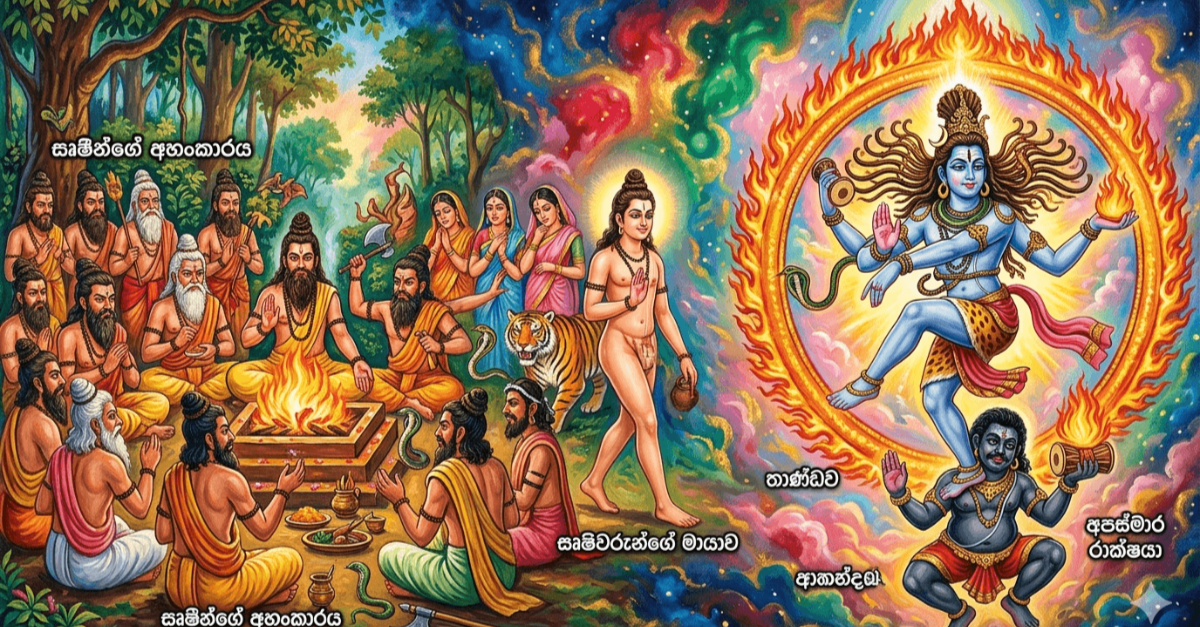
In the vast world of Hindu iconography, few forms capture the imagination quite like Lord Shiva’s Nataraja—the Cosmic Dancer. Adorning temple walls and art galleries worldwide, this dynamic posture is far more than a stunning visual. According to the Hindu Puranas, the Nataraja form represents a profound cosmic intervention, a spiritual rescue mission, and the ultimate shattering of human ego.
To understand why the Nataraja form happened, we have to travel back to the ancient forests of Daruka, where a massive philosophical conflict between ritualistic pride and supreme consciousness unfolded.
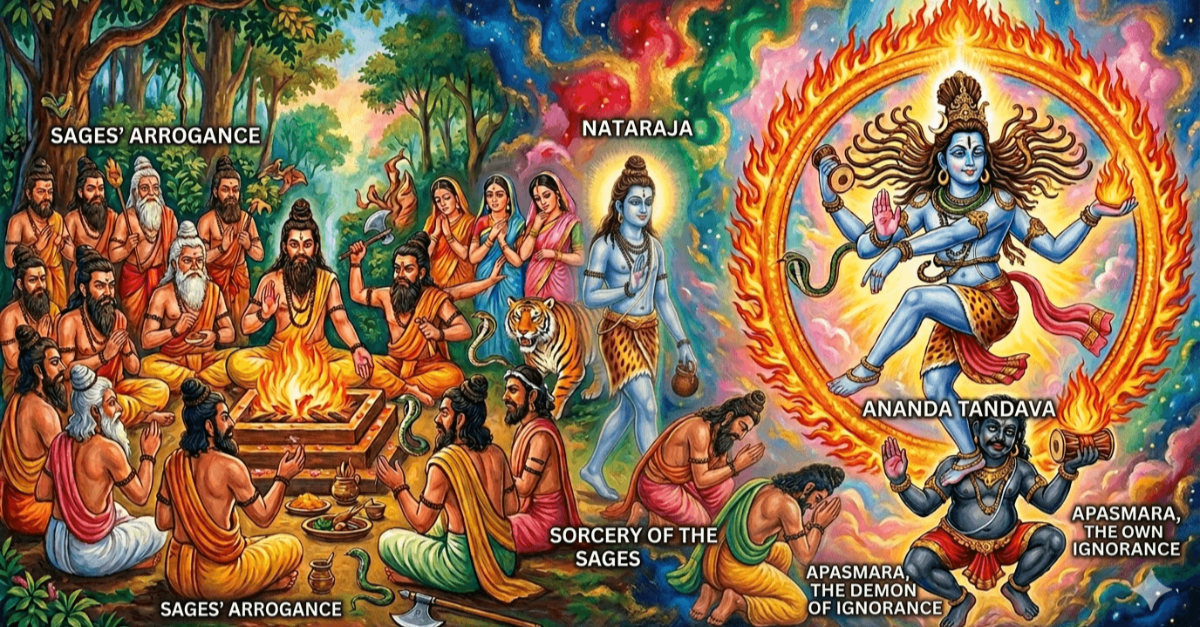
1. The Arrogance of the Sages (සෘෂීන්ගේ අහංකාරය) and Purva Mimamsa
The story begins with a group of highly learned sages (Rishis) living in the Daruka forest. These sages were fierce practitioners of Purva Mimamsa, an orthodox school of Hindu philosophy that placed ultimate emphasis on Vedic rituals, sacrifices (Yajnas), and the literal execution of action (Karma).
Over time, a dangerous spiritual blindness crept into the forest. The sages began to believe that the rituals themselves held supreme power. They argued that if a sacrifice was performed perfectly, the universe was forced to grant results, completely independent of any divine will. They fell into deep intellectual arrogance, believing that they could control destiny through their actions alone, entirely sidelining the supreme consciousness. Their spiritual practices had transformed into absolute, unyielding ego.
2. The Divine Intervention of Lord Shiva (ශිව දෙවියන්ගේ මැදිහත් වීම)
To break this dangerous illusion and restore true spiritual alignment, Lord Shiva decided to intervene. He did not arrive with weapons, but with divine trickery. Shiva manifested as Bhikshatana, an enchantingly beautiful, naked wandering ascetic, while Lord Vishnu accompanied him as the mesmerizing enchantress, Mohini.
As they strolled into the Daruka forest, their sheer cosmic presence disrupted the rigid atmosphere. The wives of the sages were instantly captivated by the beauty of Bhikshatana, while the sages themselves forgot their solemn rituals, entirely infatuated by Mohini. In a matter of moments, the highly disciplined, ego-driven order of the forest collapsed into emotional chaos, proving that the sages had no real control over their own minds.
3. The Illusion and Sorcery of the Sages (සෘෂිවරුන්ගේ මායාව)
When the Rishis realized they had been tricked, their shame quickly mutated into blinding rage. Gathering on the sacrificial grounds, they combined their collective ritualistic powers to create dark sorcery, aiming to destroy the wandering ascetic.
From the sacrificial fires of their anger, they summoned terrifying elemental forces:
- They sent a ferocious, roaring tiger—Shiva effortlessly skinned it with his fingernail and wrapped it around his waist.
- They unleashed a massive, venomous serpent—Shiva calmly caught it and wore it as a necklace around his throat.
- They directed weapons, mantras, and burning embers—Shiva simply absorbed them into his divine aura.
4. The Crushing of Apasmara (අපස්මාර රාක්ෂයා)
Seeing all their cosmic weapons fail, the sages channeled the absolute distillation of their arrogance, ignorance, and spiritual blindness into a single entity. From the sacrificial fire emerged Apasmara Purusha—a fierce, dwarflike demon representing total ignorance, forgetfulness, and the unbridled human ego.
Apasmara rushed forward to crush the divine ascetic. However, Lord Shiva simply smiled. He lightly stepped upon the back of the demon, pinning him to the ground. Shiva did not kill Apasmara, because total ignorance is a natural part of the material universe that must be kept under control, not utterly destroyed. By placing his foot firmly on Apasmara, Shiva symbolized the absolute subduing of the ego.
5. The Manifestation of Nataraja and the Ananda Tandava (ආනන්ද තාණ්ඩව)
With the demon of ignorance pinned firmly beneath his foot, the supreme consciousness broke forth. Lord Shiva assumed the magnificent form of Nataraja and began to perform the Ananda Tandava—the Dance of Absolute Bliss.
Surrounded by a halo of cosmic fire, his hair flying wildly across the cosmos, Shiva danced with such overwhelming beauty and power that the universe vibrated. The dam of the sages' arrogance broke completely. Witnessing this cosmic dance, their intellectual illusions shattered, and they fell to their knees, realizing that the rituals they prided themselves on were just tiny drops in the infinite ocean of Shiva's divine energy.
The Eternal Secret of the Cosmic Dance
The Nataraja form is a visual map of spiritual liberation. Every detail of the posture contains a hidden key for the modern seeker:
- The Upper Right Hand: Holds the Damaru (drum), symbolizing the first vibrations of creation and the passage of time.
- The Upper Left Hand: Holds Agni (fire), symbolizing destruction and the purification of the soul.
- The Lower Right Hand: Displays the Abhaya Mudra, assuring the seeker: "Do not fear, your ego can be overcome."
- The Raised Left Foot: Points upward, symbolizing Moksha (liberation) and the path to soaring above material illusions.
Ultimately, the story of Nataraja reminds us that no matter how much knowledge or ritualistic success we accumulate in life, true liberation only happens when we step away from intellectual arrogance, subdue our inner Apasmara, and allow our souls to dance in harmony with the supreme divine rhythm.

Comments