
Cyber Resilience: The Next Level of Cybersecurity
Why stopping threats isn't enough anymore—and how to build a business that can survive anything.
For years, the gold standard of digital safety was traditional cybersecurity: building walls high enough and locks strong enough to keep bad actors out. But in today's hyper-connected, AI-driven threat landscape, prevention is no longer a guarantee. It is no longer a question of if an organization will face a disruption, but when.
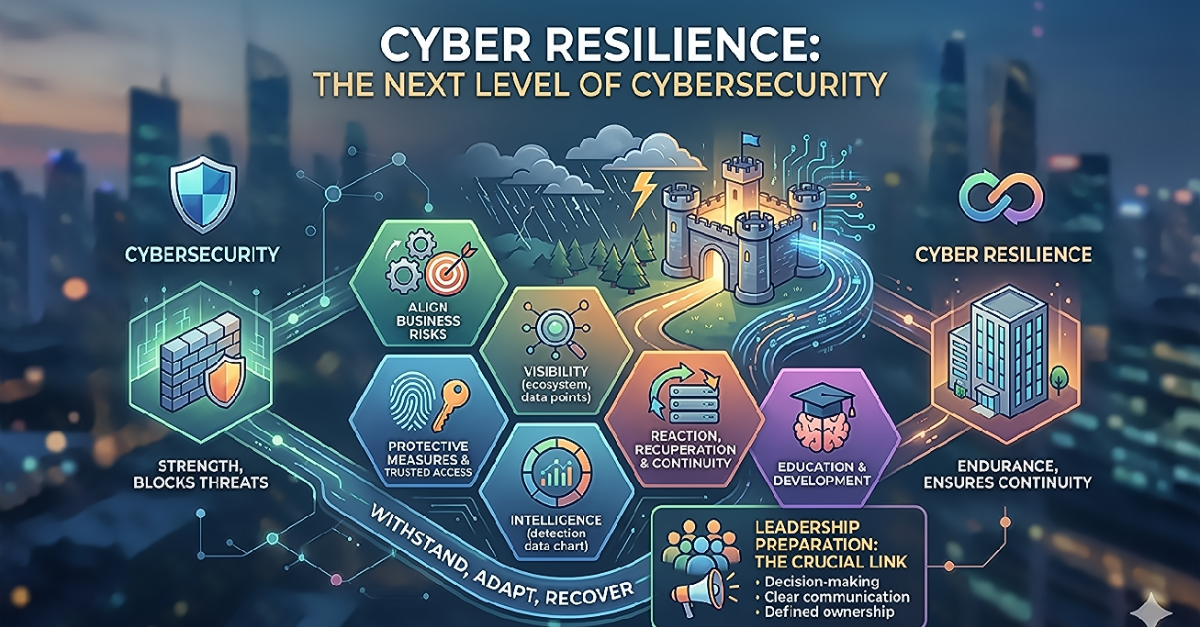
This reality has triggered a massive shift toward cyber resilience. While cybersecurity focuses on defense, cyber resilience focuses on survival and continuity. It assumes breaches will happen and prepares the entire enterprise to absorb the blow, adapt, and keep moving forward without missing a beat.
The 6 Pillars of True Cyber Resilience
Transitioning from basic security to true resilience requires a holistic framework. A resilient strategy is built on six foundational pillars:
- ✓ Alignment of Business Risks: Cyber strategy cannot exist in an IT silo. It must be directly mapped to overall business goals, regulatory obligations, and financial risk tolerances.
- ✓ Visibility Across the Ecosystem: You cannot protect what you cannot see. Organizations need total clarity over identities, third-party suppliers, digital dependencies, and physical or cloud assets.
- ✓ Protective Measures and Trusted Access: Implementing zero-trust architectures, robust authentication, and proactive defense shields to safeguard critical entry points.
- ✓ Intelligence for Detection and Decision-Making: Leveraging real-time data and threat intelligence to spot anomalies early, allowing leaders to make informed, fast decisions under pressure.
- ✓ Reaction, Recuperation, and Continuity: Having battle-tested incident response blueprints that minimize downtime and restore core operations swiftly during a crisis.
- ✓ Education, Confidence, and Ongoing Development: Building a continuous loop of learning, phishing simulations, and skills development to keep human defenses as sharp as the software.
The Fatal Flaw: Neglecting Leadership Preparation
When organizations invest in cyber resilience, they often default to buying shinier software or hiring more engineers. However, tech is only one piece of the puzzle. The most frequently neglected component of resilience happens at the executive level: leadership preparation.
"Even with excellent tools and visibility, recovery during a crisis is considerably more difficult if there is unclear decision-making, communication, and ownership. People and procedures are just as important to cyber resilience as technology."
When a major breach hits, a chaotic boardroom is more damaging than the malware itself. If executives don't know who has the authority to shut down systems, who handles law enforcement, or how to communicate transparently with customers and the media, the recovery timeline doubles.

Comments