
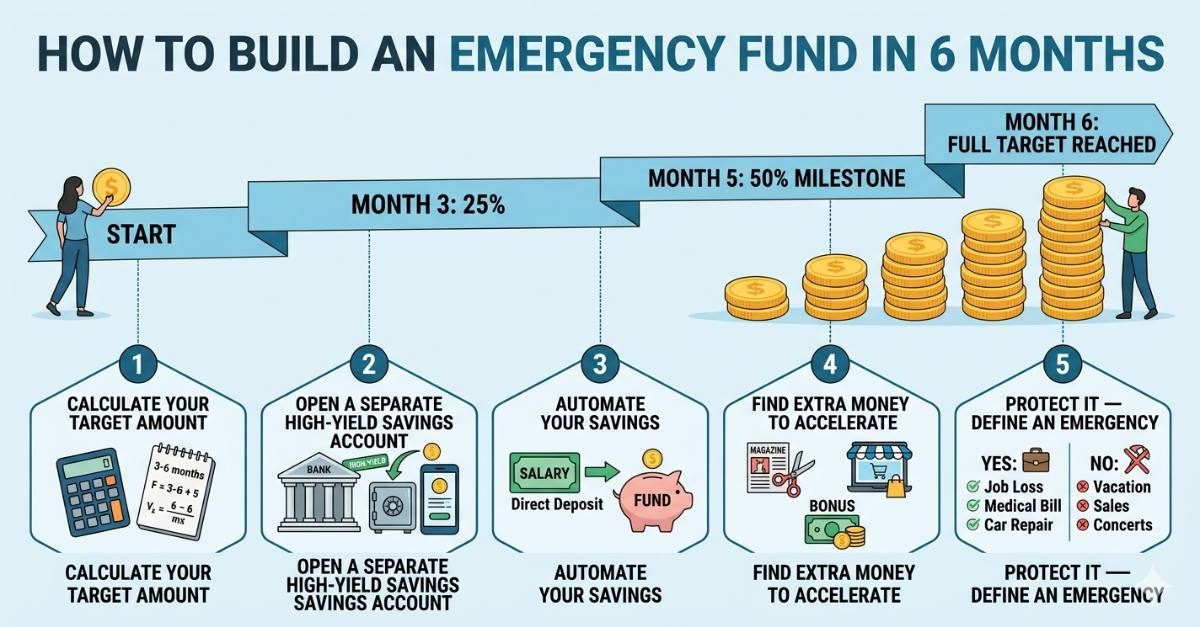
Financial advisors universally agree on one thing: before investing, before paying off debt aggressively, you need an emergency fund. Yet 57% of adults cannot cover an unexpected $1,000 expense from savings. Here's how to fix that in six months.
What Is an Emergency Fund?
An emergency fund is three to six months of essential living expenses kept in a liquid, low-risk account. It covers genuine emergencies — job loss, medical bills, car repairs, urgent home repairs — not wants, holidays, or planned expenses. Its purpose is to prevent you from going into debt when life surprises you.
Step 1: Calculate Your Target Amount
Add up your monthly essentials: rent or mortgage, utilities, groceries, transport, insurance, and minimum debt payments. Multiply by three for a starter fund (suitable if you have stable employment and no dependants) or six if you are self-employed, have children, or work in an unstable industry.
Step 2: Open a Separate High-Yield Savings Account
Keep your emergency fund completely separate from your everyday account — this removes the temptation to dip into it. Online banks typically offer high-yield savings accounts with 4–5% annual interest, meaning your money grows while it waits. Look for accounts with no fees and no minimum balance requirements.
Step 3: Automate Your Savings
Set up an automatic transfer on the day you receive your salary. Even $50 per week adds up to $2,600 in a year. Automation removes the willpower requirement entirely — the money moves before you have a chance to spend it. Start with whatever amount you can manage and increase it as your budget improves.
Step 4: Find Extra Money to Accelerate
Review your subscriptions and cancel any unused ones. Sell items you no longer need on Facebook Marketplace or eBay. Pick up one extra shift or freelance project per month. Direct any windfalls — tax refunds, bonuses, gifts — entirely into the fund. These accelerators can cut your timeline in half.
Step 5: Protect It — Define What Counts as an Emergency
Before an emergency happens, write down what qualifies. Typical yes: job loss, medical bill, car breakdown preventing you from getting to work. Typical no: concert tickets, a sale on electronics, a holiday. Having this definition in writing prevents rationalisation when emotions are high.
The 6-Month Timeline
- Month 1–2: Open the account, automate the transfer, set your target
- Month 3–4: Review and cancel unused subscriptions, add any windfalls
- Month 5: Reach 50% of target — your biggest psychological milestone
- Month 6: Hit your full target and redirect the monthly saving to investments or debt
What to Do Once It Is Funded
Keep it fully funded and leave it alone. Rebuild it immediately if you ever use it. Once you have your emergency fund, you are ready to start investing — your financial stress will drop significantly knowing you have a buffer between you and disaster.



Comments